
Berlin TV Tower:

Alright, friends,
I’m probably one of the few Berliners who are actually at Alexanderplatz almost every single day.
And because of that, I see the TV Tower every day.
For many: a photo spot
For me: everyday life
And that’s exactly where the difference begins.
The Berlin locals recommend.

What is the Berlin TV Tower? (quick explanation)
It was built between 1965 and 1969 in East Germany (GDR) and originally served as a central broadcasting tower for television and radio.
Today, it represents the divided history of the city—and at the same time, the reunified Berlin. With over 1.2 million visitors each year, it is one of the most visited attractions in Germany.
The Berlin TV Tower is located in the center of Berlin at Alexanderplatz.
At 368 meters, it is the tallest structure in Germany and still transmits radio and television signals today.
The observation deck is located at 203 meters, and the revolving restaurant sits at 207 meters.
The elevator takes around 40 seconds to reach the top.

Why was the Berlin TV Tower built?
The Berlin TV Tower was built to ensure nationwide television coverage in East Germany (GDR) while also serving as a political symbol of the strength of the socialist system.
With its height and central location, it was designed to demonstrate presence—especially in comparison to West Berlin.

10 years of chaos: planning, cancellation, restart
What many people don’t know:
The Berlin TV Tower was not originally a project from 1965.
The idea goes back to the early 1950s.
First plan:
- Location: Müggelberge
- Construction started
- Stopped after several years
Reason:
Flight path of Schönefeld Airport
Second attempt:
- Location: Friedrichshain
- Construction prepared
- Stopped again
Reason:
Financial problems, economic crisis in the GDR
So the project was started—and killed—twice before it was ever built at Alexanderplatz next to World clock.

“This is where it belongs” – a political decision, not a plan
In 1964, everything changed.
Walter Ulbricht stood in front of a city model, pointed at Alexanderplatz, and said:
“Here, comrades—this is where it belongs.”
There was no discussion.
It was a decision.
And from that moment on, one thing was clear:
The tower wouldn’t just be built. It would be forced into the center.

Construction: fast, expensive, political
Start of construction: 1965
Completion: 1969
Construction time: just 4 years
What sounds fast on paper was, in reality, pushed through under massive pressure:
- Over 300 companies involved
- Construction ran in shifts (day and night)
- Heavy political pressure
Materials used:
- Around 8,000 m³ of concrete
- Thousands of tons of steel
- Total weight: over 30,000 tons
Costs:
- More than 130 million marks
- Around 4 times higher than originally planned
And typical for the GDR:
There was never a final official cost calculation. Expenses were distributed across multiple institutions

Demolition in the heart of Berlin
For the construction, the historic Marienviertel was completely cleared.
- Buildings were demolished
- Residents were relocated
- Some structures were even blown up
All of this—just to make space for a symbol.
During the construction of the Berlin TV Tower between 1965 and 1969, several workers reportedly lost their lives in construction accidents.
However, East Germany never officially published an exact number.
That reflected the political reality of the time:
The tower was meant to represent progress, strength, and the technological power of the GDR.
Fatal accidents, construction problems, or delays did not fit that image — which is why many of these incidents were rarely discussed publicly.

The sphere: engineering and symbolism
The sphere is the centerpiece.
- 32 meters in diameter
- Around 200 meters above ground
- Built from more than 200 individual segments
And the key detail:
It was fully pre-assembled on the ground.
Then lifted up piece by piece.
The assembly alone took several months.
And here’s the contradiction:
The stainless steel came from West Germany.
A socialist prestige project—built with materials from the West.
Why is the Berlin TV Tower a sphere?
The spherical shape was not a coincidence.
It served several purposes:
Maximum volume with minimal surface area → ideal for technology, the restaurant, and visitor spaces
Structurally efficient → even load distribution
Aerodynamically stable → less resistance to wind
And at the same time:
👉 A deliberate symbol
The sphere references the Soviet Sputnik satellites, representing progress, space exploration, and the future—a central theme in GDR architecture of the 1960s.
This exact combination is what makes the tower unique:
Technology and ideology in a single form.

How people experienced the construction
This is the layer that is often missing:
The reaction of the people.
In East Germany:
- Many were proud
- Finally, modern architecture
- A real big-city feeling
Oma Jutta experienced the construction firsthand and recalls a noticeable sense of euphoria and pride. My mother was around four years old when it officially opened.
The tower stood for:
“We can do this too”
At a time when many buildings were still damaged, outdoor toilets were common, and housing was scarce.
At the same time:
- Mockery
- Rumors
- Irony
Nicknames like:
“Saint Walter”
People celebrated the tower—but never took it completely seriously.

In West Berlin:
- Often ignored
- Mocked as a “chimney”
- Criticized as a symbol of power
People didn’t want to give it that kind of importance.
Didn’t work.
It was simply too big to ignore.

The “Pope’s Revenge”
When sunlight hits the sphere, a cross appears.
Right in the middle of an officially atheist state.
The nickname:
“The Pope’s Revenge”
And yes—there were real attempts to remove it. Without success.

A tower against West German television
A key point:
East Germany (GDR) had limited broadcasting frequencies.
Western channels were often stronger.
Many East Germans watched West German television.
The TV Tower was the answer:
- Higher
- Stronger
- Broadcasting with greater reach
Similar to the expansion of the Berlin U-Bahn, it was also about making infrastructure and influence visible.
The Berlin TV Tower Helped Bring Color Television to East Germany
What many people don’t know today: When the Berlin TV Tower officially opened in October 1969, it also marked the beginning of a new television era in East Germany.
At the same time as the GDR celebrated its 20th anniversary, the second television channel went live — officially launching color television in East Berlin and large parts of East Germany.
The tower played a central role as the new main broadcasting station for this modern technology.
While West Germany had already introduced color TV in 1967, East Germany followed two years later using the French SECAM system instead of PAL. Owning a color television at that time, however, was a luxury.
The first models cost more than 2,000 East German marks, making them unaffordable for many families in the beginning.

Opening and impact
Opening:
October 3, 1969 (official)
October 7, 1969 (open to visitors)
At the same time:
Launch of color television in East Germany (GDR)
In the first three years over 4 million visitors
The tower immediately became:
- An attraction
- A symbol
- A meeting point
However, when the weather is bad, you quickly notice how limited the experience up there really is—there are far better alternatives in Berlin on rainy days.

From a GDR symbol to a Berlin landmark
After 1990:
- Demolition was discussed
- The idea was rejected
- Deutsche Telekom took over
- Modernization followed
Since then:
More than 50 million visitors
Similar to places like Kunsthaus Tacheles or World clock the TV Tower shows how the meaning of places in Berlin can completely change over time.
What specifically changed here:
The tower was depoliticized.
And that’s exactly why it works today.

View, restaurant—and the reality
Facts:
- Observation deck at 203 m
- Restaurant at 207 m
- 360° view
- Up to 40 km visibility
But honestly:
You see everything—except the Berlin TV Tower itself.
And that’s exactly the point:
- It’s a place for perspective
- Not for real Berlin
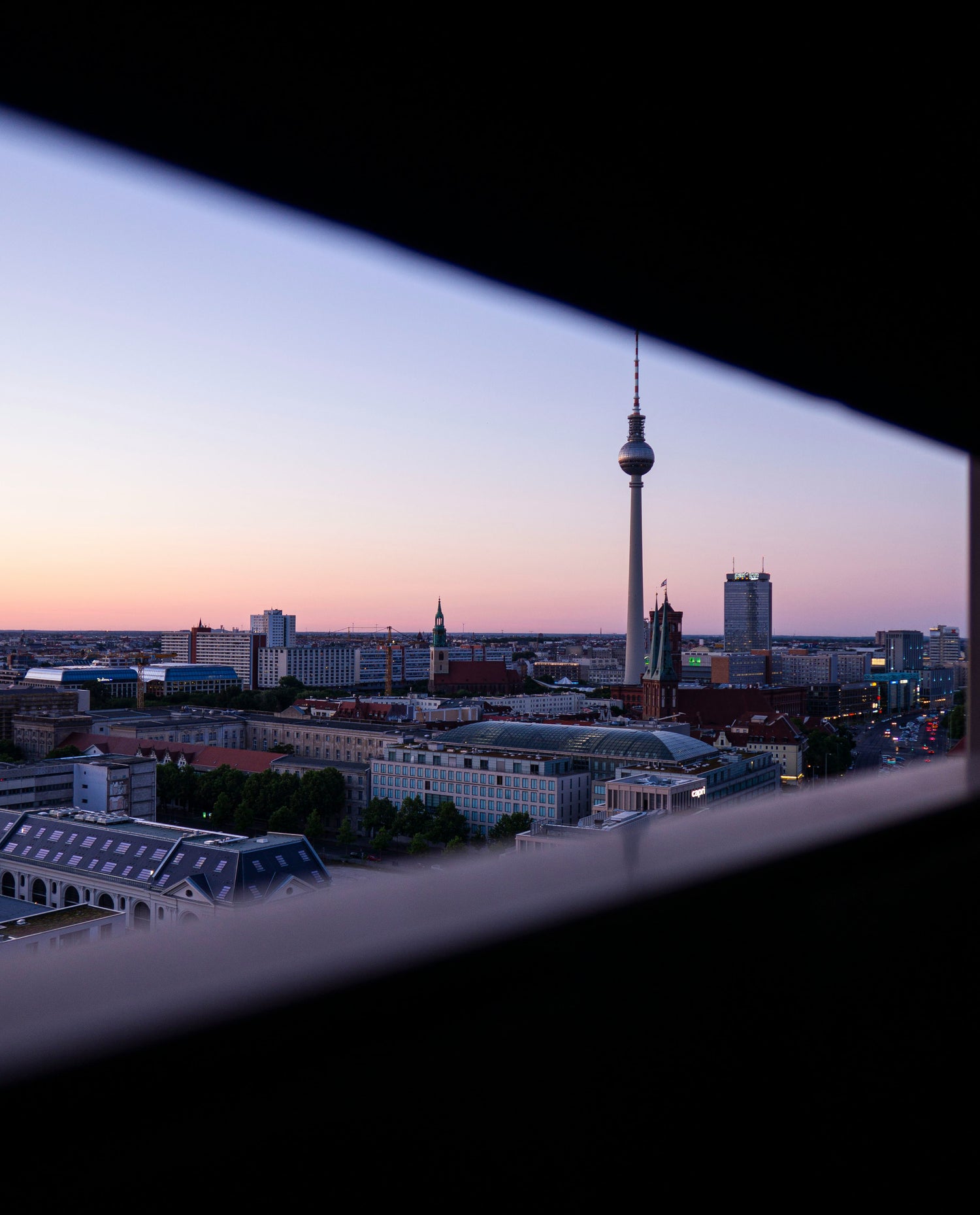
My view of the Berlin TV Tower
I see it every day.
Prenzlauer Berg, Greifswalder Straße—always somewhere in the background.
My gym used to be right at Alexanderplatz.
My best friend works as a concierge at Park Inn by Radisson Berlin Alexanderplatz.
My cousin works at a bank there as well.
For me: Completely normal
For many Berliners: Not at all
Especially people from the western parts of the city might only see Alexanderplatz together with the TV Tower once or twice a year.

Meeting point: World Clock
Berliners from the eastern parts of the city will remember.
Just a few meters from the Berlin TV Tower stands the Weltzeituhr.
Back then:
- Meeting point: World Clock
- Then move on
Today:
- Selfies
- TikTok
- Groups
I’ve personally sent thousands of tourists there.
Even though I knew:
Berlin happens somewhere else.

Why many Berliners misunderstand the TV Tower
Many people say:
“Alex is terrible” or “That’s not our landmark”
Maybe that’s true.
But:
Once you know the history, everything changes.
Then the tower is no longer just a structure.
It becomes:
- Cold War
- Contrast
- Propaganda
- Technology
- Everyday life
And that’s exactly what Berlin is really about—even as a visitor.

Conclusion: more than just a landmark
The Berlin TV Tower was built to show who holds the power.
Today, it simply stands there.
And that’s exactly what makes it strong.
It has outlasted everything.
System.
Criticism.
Time.
Check out our blog posts here about the Brandenburg Gate, Museum Island, or the KaDeWe.
Berlin is not a sightseeing attraction. Berlin is a city.
We’ll see each other in the real Berlin—or here in the next blog.
Take care 🖤
Sources and references: Book "Der deutsche Fernsehturm" by Rudolf Pospischil | Book "Fernsehturm Berlin" by Lothar Heinke | Book "Das Buch vom Fernsehturm" by Berliner Kurier | Book "Berlin – Die Bauwerke" by Thomas Rosenthal and Christian Simon | Most images in this article are sample images and were not taken at the places featured.
Check out our blogs on insider tips for Berlin.
View all-

Bundestag
The Bundestag is about more than its dome and views over Berlin. Find out what really happens in parliament, how you can visit the Bundestag – and why it’s worth...
Bundestag
The Bundestag is about more than its dome and views over Berlin. Find out what really happens in parliament, how you can visit the Bundestag – and why it’s worth...
-

Planetarium Berlin
The Zeiss-Großplanetarium is far more than just stargazing. Find out what to expect at the Berlin Planetarium, why this GDR-era building still impresses today – and whether it’s really worth...
Planetarium Berlin
The Zeiss-Großplanetarium is far more than just stargazing. Find out what to expect at the Berlin Planetarium, why this GDR-era building still impresses today – and whether it’s really worth...
-

Festival of Lights Berlin 2026
The Festival of Lights Berlin 2026 transforms the city with light art, projections and 3D mappings. Discover our route, the best highlights, practical tips – and whether the festival is...
Festival of Lights Berlin 2026
The Festival of Lights Berlin 2026 transforms the city with light art, projections and 3D mappings. Discover our route, the best highlights, practical tips – and whether the festival is...


